
Montessori Mathematics Programme at Crayons Montessori
Mathematics is a key component of the Montessori method of education, and is introduced to children in a concrete, hands-on way. The Montessori mathematics materials in day care in south delhi hauz khas are designed to help children understand mathematical concepts through direct experience and exploration, rather than through memorization or abstract symbols. The Montessori mathematics materials include a wide variety of objects and tools, such as the number rods, the spindle box, and the bead chains. These materials in day care in south delhi hauz khas are carefully designed to help children understand concepts such as counting, addition, subtraction, multiplication, and division. The materials are presented to children in a specific order, to help them build their skills in a logical and systematic way.
At Crayons Montessori, children begin mathematics by working with quantities they can see and handle. Counting, matching and comparing materials help them connect number symbols with actual amounts. The Montessori mathematics programme moves gradually from concrete experiences towards more abstract ideas. Materials are introduced in a sequence and revisited as understanding develops. This approach makes early mathematical relationships visible before children work with written symbols alone.
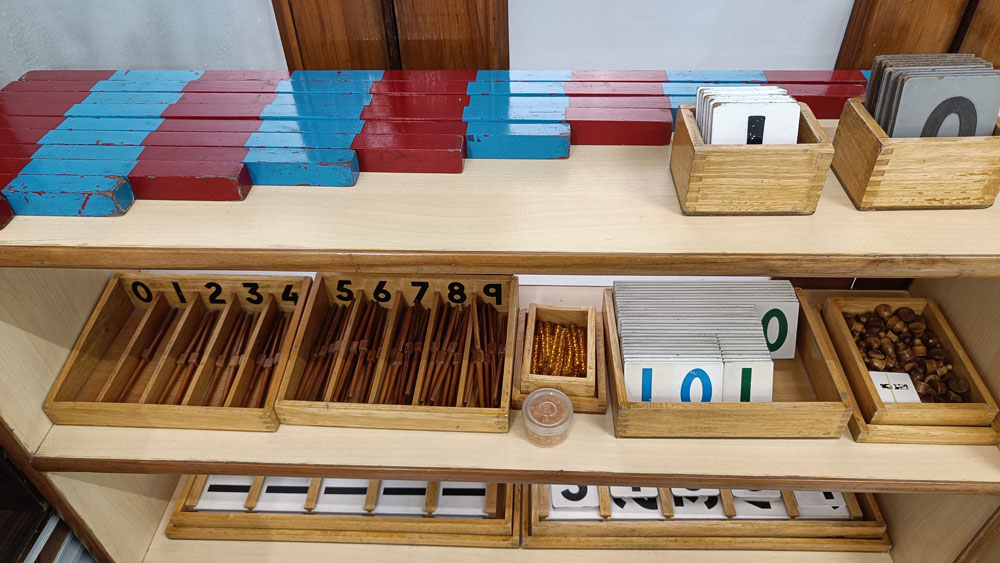
The Montessori mathematics curriculum in montessori education in south delhi emphasizes the importance of understanding mathematical concepts rather than simply memorizing formulas or procedures. Children in play school in hauz khas are encouraged to explore and experiment with the materials on their own, and to develop their own solutions to mathematical problems. The Montessori approach to mathematics in montessori education in south delhi is designed to help children develop a love of learning and an appreciation for the beauty and order of the mathematical world. By working with the materials in a concrete and hands-on way, children develop a deep understanding of mathematical concepts that will serve them well throughout their lives. The Montessori approach to mathematics in play school in hauz khas is an integral part of the Montessori method of education, and is an important way for children to develop their mathematical skills and understanding.
Number Rods: Exploring Quantity and Sequence
Number Rods give children a visual way to explore quantity and number sequence. By arranging rods of different lengths, they can compare amounts, place them in order and see how quantities increase. Repeating the activity gives children a chance to check their ordering and become familiar with the sequence.
Sandpaper Numerals: Connecting Symbols with Numbers
Sandpaper Numerals introduce the written forms of numbers through sight and touch. Children trace each numeral to explore its shape and become familiar with the symbol. As they progress, children can connect the numeral they have traced with a quantity represented by other Montessori materials.
Spindle Boxes and Early Number Understanding
Spindle Boxes help children connect numerals with quantities. Children count individual objects and place the correct number in each compartment, practising one-to-one counting and following a sequence.
From Concrete Materials to More Advanced Concepts
When foundational number concepts are secure and a child is ready, activities may extend to number sequences, the decimal system and basic arithmetic. Materials continue to make relationships visible as children move towards written operations. Progress is guided by understanding rather than speed. Children may revisit a concept until they can use it with confidence.
Building Concentration and Logical Thinking Through Maths
Mathematical tasks also ask children to order information, identify patterns and check results. These activities help them practise logical reasoning and problem-solving skills that can be useful beyond mathematics. The aim is for children to understand what numbers represent and how quantities relate, not simply to recite a number sequence.
Frequently Asked Questions
Montessori mathematics uses concrete materials to help children explore quantities, numerals, and relationships through direct experience. The aim is to connect symbols with meaning, rather than depend only on rote counting.
Number Rods give children a visual and hands-on way to compare quantities, explore number sequence, and notice relationships between amounts. This hands-on approach reflects Montessori maths learning rather than relying only on number memorisation.
Sandpaper Numerals introduce the shape of written numerals through visual and tactile experience. Tracing helps children become familiar with a numeral and connect its form with the number it represents.
Children count objects and place them in corresponding compartments, practising one-by-one counting and connecting numerals with quantities. The activity also reinforces sequence and careful handling.
The decimal system is introduced as children progress and are ready for more advanced mathematical concepts. Contact our team if you would like to understand how the school’s learning progression is organised.
Yes. As children progress and demonstrate readiness, the approach can introduce basic arithmetic alongside number sequence and decimal-system concepts.
Concrete materials allow children to see and handle quantities and relationships. These experiences provide a foundation for understanding mathematical symbols and more abstract concepts later.
Repetition is a valued part of Montessori learning. Returning to a material gives children time to practise, improve accuracy, and strengthen their understanding.
Mathematical activities can support number awareness, concentration, accuracy, logical thinking, sequencing, and problem-solving through purposeful hands-on work.
Progress depends on a child’s readiness and understanding. The Montessori approach allows children to practise foundational concepts before moving towards more advanced work.